
 If you are a marketing professional, you cannot ignore the power of social media. When used correctly, it is an important tool for increasing web traffic, brand reputation and online visibility.
But how can you be sure you are using social media correctly?
And how can you get the most out of your social media marketing efforts?
The first question to ask is what role does social media currently play in your marketing program?
- Customer service
- Lead generation
- Sales
- Data collection
- Ad targeting
- All of the above
If you answered “All of the above” then you are an organization with digital marketing maturity. So what do you plan to add to your social marketing strategy in 2017 to be more insightful, stronger and faster?
And how will you strategically integrate your social media strategy into all the other components of your marketing planning? After all, social media is only one part of an overall marketing strategy. Your marketing planning probably includes everything from SEO to paid, social, mobile and content media, and more.
So, here is your 2017 social media power play. This year, make it a priority to integrate your digital marketing efforts. You can make gains by applying what you learn from search marketing to your social media efforts and vice versa.
2017 continues to be a year of integrated digital marketing programs. Social media, paid search, display, SEO, content, PR, email – they are all levers of an overall marketing machine.
In this article we will
- Describe the effects of social media on search engine optimization – two marketing channels with a historically fuzzy relationship.
- Share valuable tips on how to be where your social audience is.
- Offer 5 ways to integrate social media marketing data into other marketing channels such as SEO and PPC.
- Share statistics on the impact of multichannel marketing when organizations embrace integration.
The relationship between social media and SEO
First, we will start the conversation on how social media and SEO work together. Many misconceptions exist about the effects of social media on organic search rankings.
For years, people have tried to understand whether, and how, social signals impact search rankings.
In 2014, former Googler Matt Cutts said that social signals were not part of the ranking algorithm. Again in 2016, Google’s Gary Illyes confirmed this.
Meanwhile Bing has said that it uses social signals as ranking factors. From the Bing Webmaster Guidelines help files, we read:
“Social media plays a role in today’s effort to rank well in search results. The most obvious part it plays is through influence. If you are socially influential, it leads your followers to share your information widely, which in turn impacts results in Bing, which sees these positive signals. These positive signals can have an impact on how your organic ranking positions itself over the long term.”
In addition to being a factor in ranking algorithms, we know of other ways social media marketing can impact organic search.
- Social media profiles and content can appear in organic search results. This gives you more assets in search results. Take Twitter, for example. In 2015, Twitter gave Google access to its firehose, which lets Google index tweets so that they appear in organic search results. (Note: even with this access, a study showed that Google does not index all tweets, but only those it deems worthy).
- Social media mentions and activity can be a catalyst for organic search queries. It’s about being open-minded and building ever more brand visibility. In other words: social media stimulates interest. A simple tweet or Facebook update posted by a brand, or someone mentioning a brand, can then lead a person to search for that brand and its products, services or target keywords on Google. And social mentions are important to help search engines determine when people are interested in what your site is about or what your business is. Social updates may not generate useful links to your site, but they absolutely signal to search engines that people are talking about your brand. We call this “Buzz.”
And here is something to think about: it’s no secret that Google Analytics uses data aggregated across companies’ business sectors.
We can imagine a world in which Google could use social referral data to see how much traffic hits a particular social website, and compile statistics on that brand.
I am not saying Google does this or even cares about it, but the data is there to do it, should they ever want to.
OK, now that we have been clear on how social media can impact organic search, let’s talk about evolving your social media strategy.
A big part of this will depend on being where your audience is, and not trying to be everywhere at once – or being where you think you should be just because your competition is there.
For example:
- If you are a B2B, you probably have a captive audience on LinkedIn.
- If you sell a product, Facebook might be your platform.
- Trendy? See Instagram as a social community in which to put your efforts.
- If your target audience is millennial, Snapchat may be where you want to go.
- If you target women, Pinterest is worth exploring.
If you’re not sure where to start, leverage other people’s research. Nielsen and Pew Research Center have a good amount of data on social media platforms and who uses them and why.
What if you sell toilet plungers or some other obscure product or service? Well, social media is not for everyone.
You don’t have to be on social sites just to fill out a digital marketing checklist. Go where your audience is. And if that’s a “Toilet Plungers of America” trade show and not Facebook, that’s perfectly OK.
Once you have refined your social media targets, test, test and re-test.
Test your presence on your chosen platforms on both the paid and organic sides of things. Paid social advertising will generally let you see results faster (meaning, whether a campaign’s messaging works or not) and target better.
And know that each social platform has its own algorithms for surfacing content, such as Facebook, Instagram and so on.
Even Google has its own method for how it indexes tweets in its search results, so, just like SEO, you want to familiarize yourself with social algorithms in the places where you want your brand to show up.
Here are five ways to use social media data for your marketing efforts
1. Discover web content ideas from social customer service activity. Knowing the real challenges your target audience faces can help you create content that meets their needs.
2. Find web content ideas in social communities, comments and the most relevant articles. What is your target market talking about on the different social media platforms? Use this knowledge to help define your content strategy for your website, key landing pages and blog.
3. Get remarketing audiences from authorized website users and lookalike audiences from email lists. You can use this data to advertise to people who have already shown interest in your brand, products or services, or who might be very interested in what you have to offer.
4. Use social media advertising results to inform search advertising campaigns, and vice versa. Use the best-performing messages in social ads as a creative test for search ads.
5. Use link ideas from trending topics on social media. The beauty of social media is that it lets brands be part of the conversation in real time. Discover trends and think about content you can create immediately to draw internet users to your site.
Success stories of marketers integrating social media
More than 5,000 marketers weighed the benefits of social media for their businesses in the 2016 “Social Media Marketing Industry Report” by Social Media Examiner.
The top two benefits cited are increased exposure and traffic. In fact, improved search engine rankings was a widespread concept.
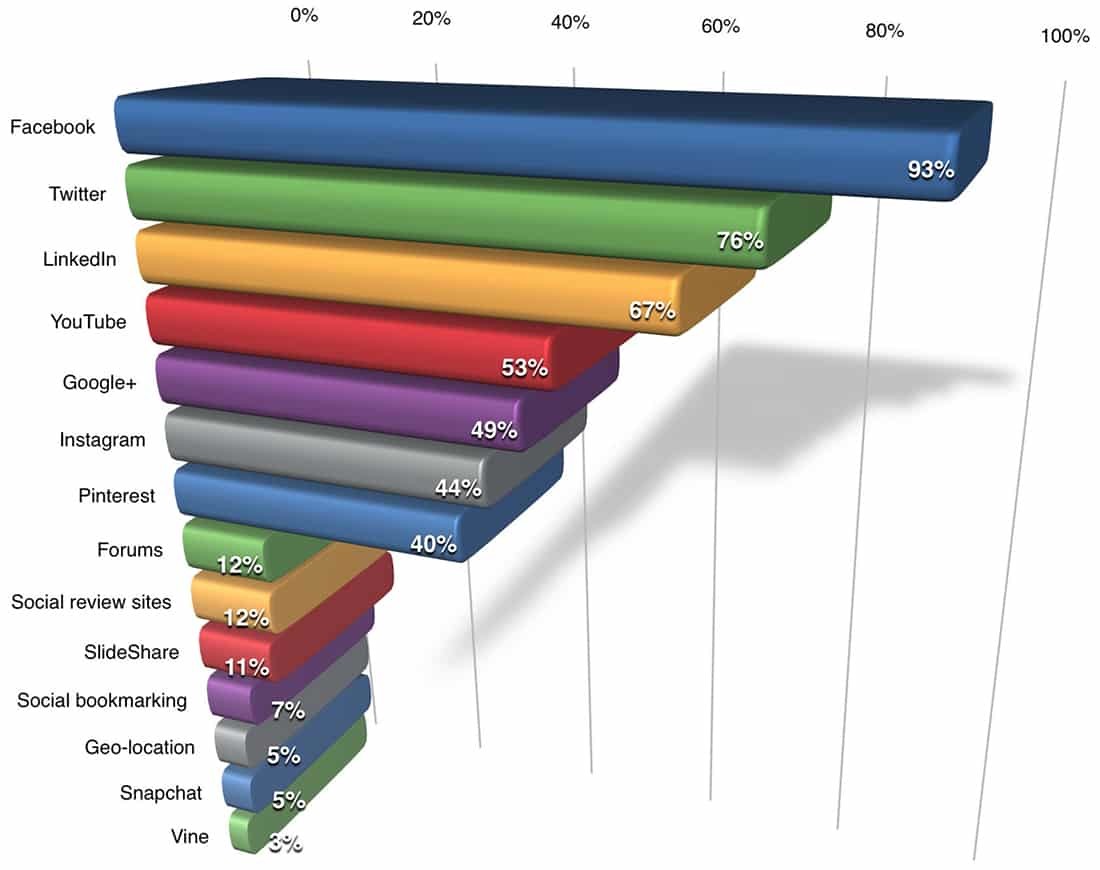
Takeaways from the report Social Media Marketing Industry Report 2016
Improved search engine rankings was most widespread among those who used social media for 1 year or more, with 54%+ reporting an increase. At least 59% of those who invest a minimum of 6 hours per week in social media marketing saw improvements in search engine rankings.
What kind of social media involvement does it take on a daily basis to see an impact on web traffic? According to the report, it is minimal;
A significant 79%+ of participants found that increased traffic occurred with as little as 6 hours per week invested in social media marketing. And those who had used social media for a year or more reported markedly better results (73%+ reported benefits), compared with those with less experience.
Your social media strategy starts here
Social media (and digital marketing in general) is a bit like going fishing. And to catch the fish, there are two things you need to do:
1. Use the right bait
2. Fish where the fish are
And since social media is only part of an overall marketing strategy, make sure to integrate social media efforts into other marketing channels in a way that makes sense for you.
Evolving your social media strategy this year is clearly about understanding how social plays a role in reaching your audience and in the other facets of your digital marketing strategy.
Once you have figured that out, you can determine how much effort should go into social media activities in order to see a return
I want to know what your biggest challenges with social media marketing are in 2017.
Let us help you drive and track traffic to your website with integrated search and social media marketing solutions. Our strategies are tailor-made to match your business goals and your audience.